Redefining Meta’s $75B AI brand in a new campaign experience
Context
Meta Advantage+ is a set of AI products that automate parts of an ad campaign, such as audience, budget, and placements. The brand has an annual revenue run rate of more than $75 billion.
Until 2025, advertisers had two separate ways to set up a campaign:
- Manual campaigns gave advertisers full control of every setting, but setups that were too narrow could lower performance.
- Advantage+ campaigns used AI across the campaign for better performance, but gave advertisers less control.
In 2025, Meta merged the two paths into one campaign setup flow with AI on by default. At the same time, a separate team launched Opportunity Score, which scores how well a campaign is set up on a scale from 0 to 100. My product design partner and I led the in-product branding for the merge, from the strategy in January 2024 to the launch test that September.
Problems
For advertisers
- Advertisers had no shared meaning for Advantage+. In research, some saw it as Meta's recommended default, others as Meta's AI, and some did not know they were using it.
- Advertisers confused the brand's two tiers, Advantage+ and Advantage. In research, 10 of 17 advertisers misused products because they mixed them up.
- The merge broke the existing mental model. Advertisers used to choose Advantage+. Now every campaign starts with it on, and advertisers turn it off by adding controls.
For the business
- The brand could promise performance that a campaign did not deliver. If every campaign carried the name, including ones with limits that lower performance, the brand would lose its core promise.
- Two teams were building products that gave advertisers competing advice, at the risk of shipping the org chart. Advantage+ and Opportunity Score both told advertisers how to improve the same campaign.
Goal
- For advertisers: Make it clear what is and isn't Advantage+.
- For the business: Keep the brand's performance promise and move more advertisers to the most automated setup, with no loss in revenue.
Key decisions
1. Define what Advantage+ means in the merged product
- I framed three strategies and scored each against eight questions, such as whether advertisers would understand it, whether it protected the brand, and whether it would still work as more campaign types merged:
# Strategy What it means Key risk 1 Advantage+ is a suite of products Brand every product, as before A campaign full of controls still carries a brand that promises performance 2 Advantage+ is the optimal campaign state The brand shows whether the campaign is set up optimally Advertisers must learn a new meaning 3 Retire the brand AI is built in, so drop the name Signals Meta lost confidence and throws away the brand - My product design partner and I recommended Strategy 2, and leaders across the merge aligned.
- I turned the recommendation into two hypotheses, and two rounds of research tested them:
- Less aggressive: The brand as an on/off label is easier to understand than the brand as a product name.
- More aggressive: Showing an overall status nudges advertisers toward more automated setups.
2. Make the Advantage+ status binary: on or off
- The first version of Strategy 2 used a scale that showed how close a campaign was to full automation, with labels such as "strong, medium, weak" and "assisted, partially assisted, not assisted." We mapped every setting change to a state, because each change raised a real question. For example, does adding an age range still count as on?
- We dropped the scale. We could not offer a fix for every partial state, so advertisers would see a status with no clear next step. Instead, we chose a strict rule: any limit turns Advantage+ off. More campaigns would show "off," but the brand would appear only on setups that met its promise.
- The same logic simplified the brand tiers. By launch, only "Advantage+" remained, and single settings appeared as plain "Budget," "Audience," and "Placements."
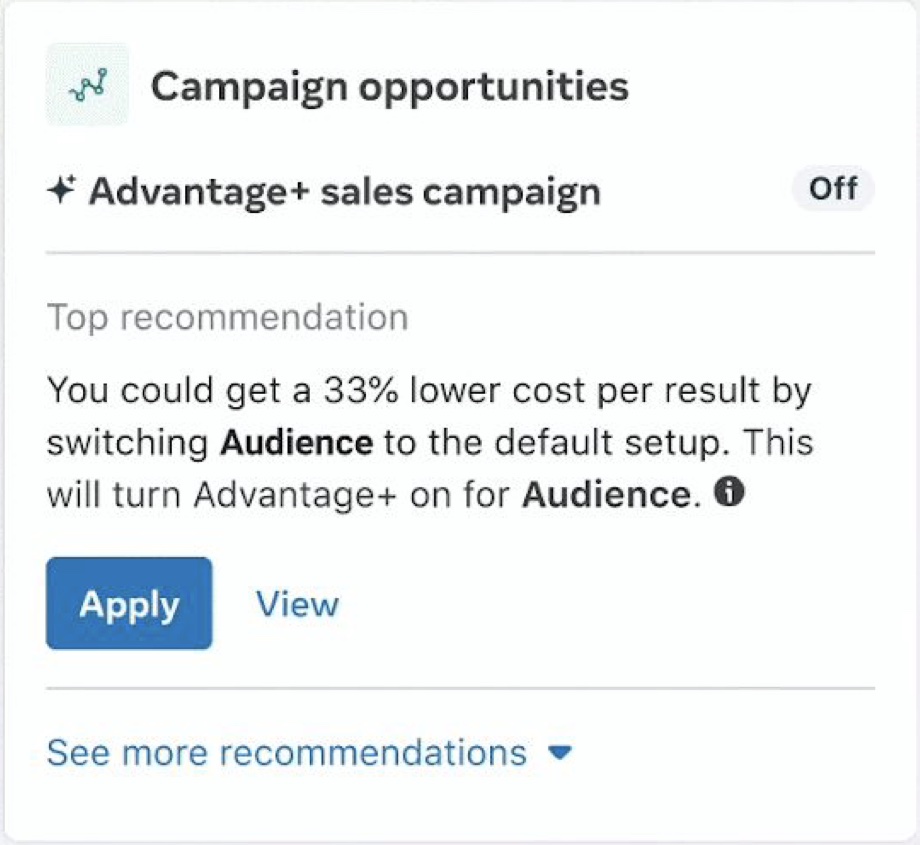
- I wrote the status copy. When Advantage+ is off, it names the cause: "You have Advantage+ off for Audience." Then it offers the fix and says what the fix will do: "Switching setups will turn Advantage+ on for Audience."
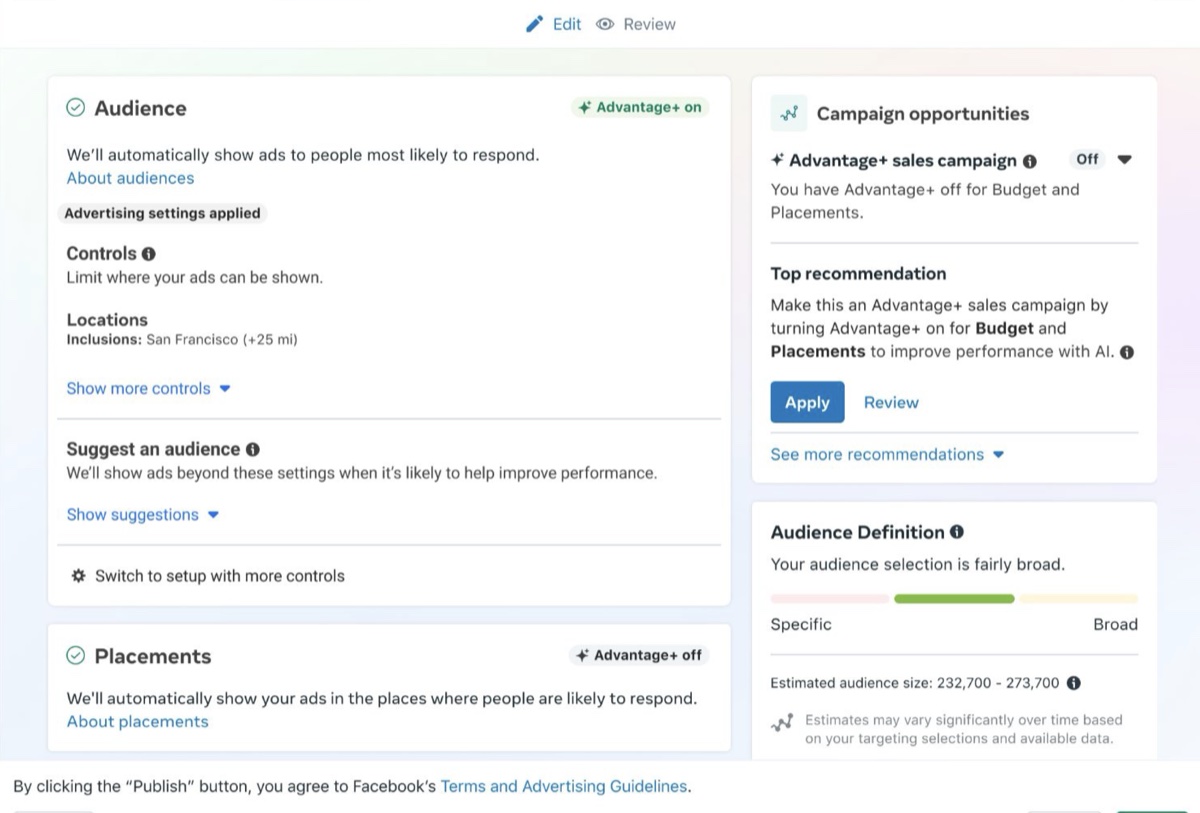
Each setting shows its own status, and the panel sums up the campaign.
3. Show the definition without crowding the panel
- In research, advertisers understood how Audience, Budget, and Placements decide the campaign's status, but only after hovering to read the definition. Most never hovered.
- We compared four levels of visibility, from the original hover to showing the definition all the time. Always showing it would push the top recommendation off screen. We chose the middle ground: the definition opens during onboarding, then collapses to a summary of what's off.
4. Put Advantage+ inside Opportunity Score
- Opportunity Score rates a campaign by how many of Meta's recommendations the advertiser applies. The two features were planned as separate tests. I raised the overlap several times. At a design review, our VP of design asked whether Advantage+ was still needed once Opportunity Score existed. Before launch, design leadership made merging them a launch blocker. Leadership also required Advantage+ to stay as a brand.
- My product design partner and I co-led a sprint and a cross-team workshop with the Opportunity Score team. We worked to one rule: neither product could weaken the other's promise. A score that ignored Advantage+ would undercut the brand. An Advantage+ panel beside the score would give advertisers two answers to one question.
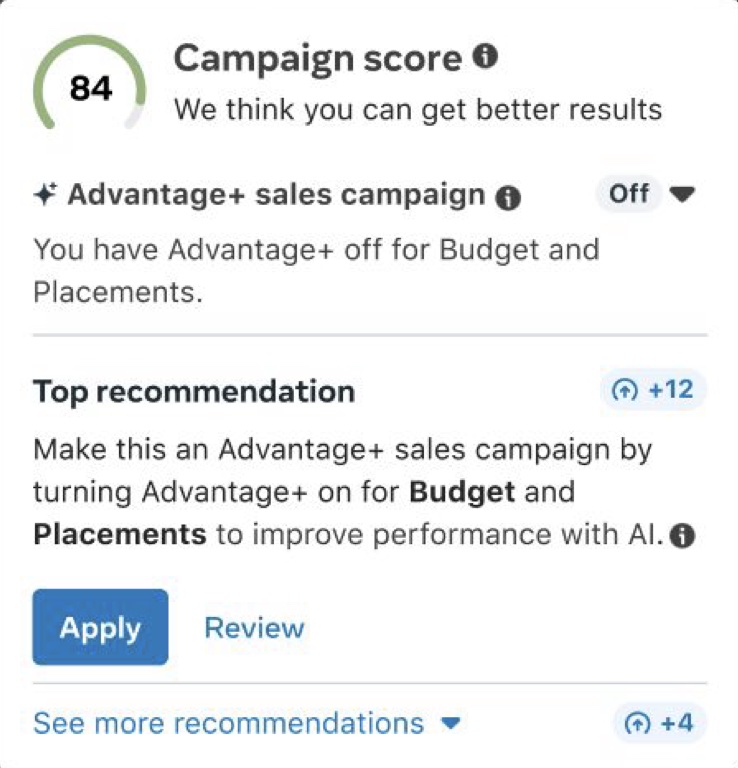
- We put Advantage+ inside Opportunity Score as its main lever: its recommendations appear first and carry more weight in the score. We gave up a panel that showed only Advantage+, so advertisers would see one answer instead of two.
- The Advantage+ status sits under the campaign score in the right panel, which stays visible beside every setting.
- I also redesigned the onboarding flow for the combined experience with fewer screens. It received VP sign-off and shipped within one month.
Outcomes
- The merged setup surpassed its launch goals, with no loss in revenue and no drop in automated setups. Adoption of the optimal Advantage+ state rose 1.1%.
- In research, advertisers understood the new meaning. One said it was "very clearly defined" when they were or weren't in an Advantage+ campaign. Another said: "In just 2 clicks I had everything change to Advantage+ on, it's a very pleasant experience."
Reflection
- Get data sooner: Research confirmed that advertisers understood the design, but we had to wait for the launch test to learn whether the label changed how they set up campaigns. Next time, I would push for an earlier quantitative test.
- Document principles earlier: I would write down the principles and content patterns sooner, so the wider ads design team could adopt them across Ads Manager.
Peer feedback
"His leadership in defining the Advantage+ brand evolution strategy was integral to derisking the merge."Product Manager
"Got buy-in from cross-functional stakeholders on content decisions by clearly communicating design rationales, using key frameworks he developed to support arguments."Product Designer
"Nikhil updated the content so quickly and with quality in all iterations in the design that there was no back and forth required for this project even though it had a lot of moving parts."Software Engineer