Showing advertisers how Meta uses their data without hurting adoption
Context
To learn more about a business from an Instagram or Facebook ad, people usually have to tap it and leave the app. Meta now shows more business information inside the ad itself, like a summary, more product images, or links to other pages on the advertiser's website. These are called interactive experiences.
Interactive experiences use metadata from the advertiser's ad sources, like their website, product catalog, or app store listing.


Problems
For advertisers
- Advertisers saw changes in their ads they did not expect. Interactive experiences were on by default, in a sub-menu few advertisers opened, so many could not find where they had opted in or how to opt out.
- Advertisers could not connect their metadata to the interactive experiences it powered. Ad sources and the features they powered sat in different steps of setup.
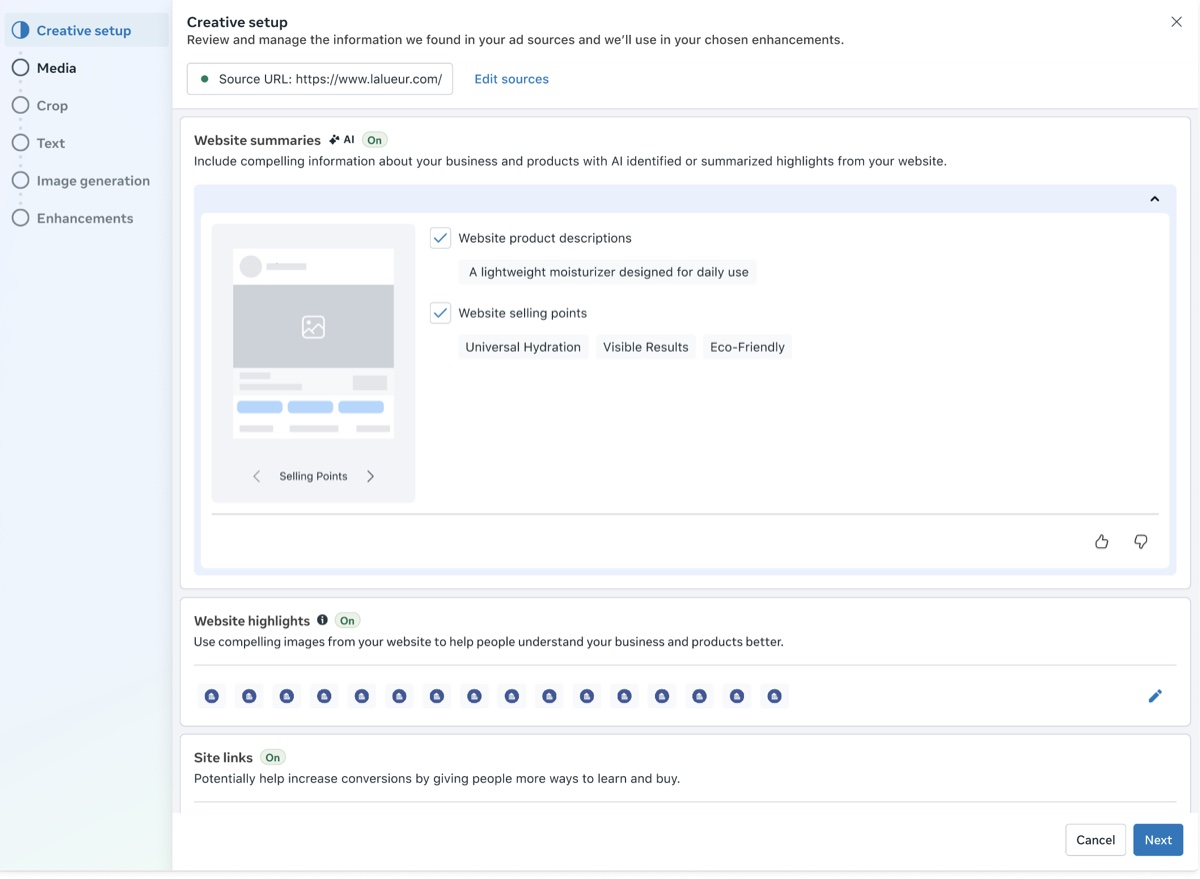
Old experience: in the first step of this modal, advertisers opt into ad sources.
For the business
- Transparency had already failed once. An earlier test moved interactive experiences up in the creative modal, adoption dropped by 14.8%, and the team rolled it back.
- Meta needed low opt-out rates to launch to every advertiser. Those opt-outs had to come from informed choices, not confusion.
Goal
Show advertisers how their metadata appears in interactive experiences without losing adoption. We tracked three measures:
- Transparency: More advertisers see the new card than saw the old preview screen.
- Adoption: No drop.
- Control: Fewer than five advertiser escalations a month.
Key decisions
1. Ask advertisers why they opted out
- Most decisions about what to show in-product were guesses. With our UX researcher, I designed an in-product survey that asked advertisers why they turned interactive experiences off.
- The answers pointed to one cause: advertisers could not connect their ad sources to the features they powered. That set the direction for the redesign: put them side by side.
2. Put metadata and interactive experiences in one new card, and move control to the metadata
- My product design partner and I outlined four places these products could live:
Number Option Result 1 Metadata and interactive experiences on one screen in the creative modal Too much to review at once 2 A new card in ad setup, with metadata shown in context Visible and focused 3 Move into the creative modal A related test cut adoption 4 Keep in advanced preview Still hidden - We proposed #2, which shipped.
- We also proposed replacing the on/off switch for each experience with a choice of which ad sources flow into it. This only works if advertisers can see which data powers which feature, so I shaped the content around two principles:
- Show every pairing. Advertisers see the ad sources that feed each interactive experience, with a preview of the result.
- Give each pairing its own control. Advertisers can stop one ad source from feeding one interactive experience without turning off anything else.
- This took advertisers from about six choices to twelve. We accepted the longer list because it made each link visible.
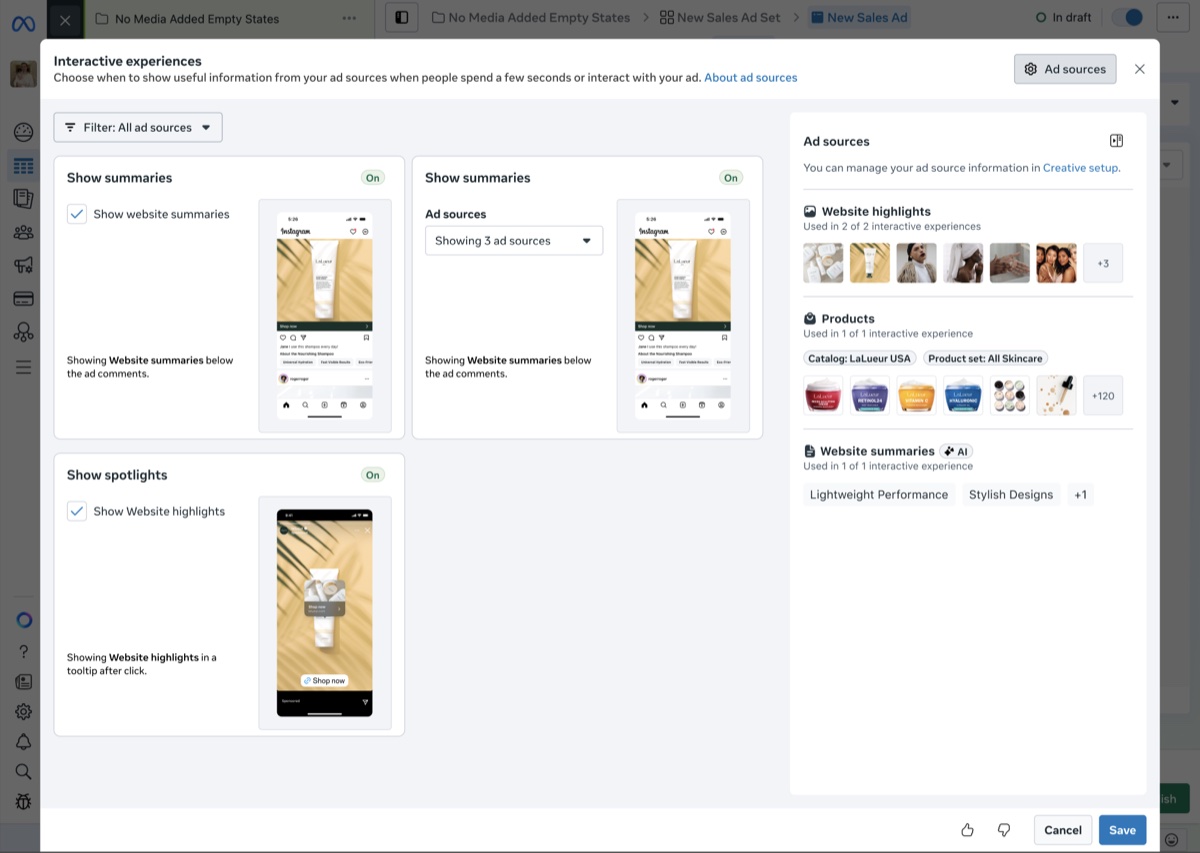
New experience.
3. Name and group a new kind of feature
- These products needed a name advertisers would not confuse with creative enhancements, which alter the advertiser's image or video. Grouping the two could make interactive experiences seem riskier.
- I put forward several names, and the team aligned on "interactive experiences" because it described what people do with the ad. Under it, I built a four-layer naming system so each name told advertisers one thing.
Layer Name What it tells advertisers 1 Category Interactive experiences Products that control what people can see and do after spending a few seconds with your ad 2 Ad products Show summaries, Show spotlights, Reveal details over time What advertisers will opt into; follows Ads Manager naming conventions 3 Metadata source Ad sources Where the information comes from 4 Metadata Information from your ad sources Information
Outcomes
- Interactive experiences shipped to all advertisers by mid-2026, and met every target: 99% kept their ad sources on, with zero escalations to our sales teams.
- Most importantly, we proved that transparency at the right moment builds trust, which cleared the way to move all interactive experiences and ad sources into the new card.
Reflection
- I would question inherited rules sooner. One rolled-back test had turned into the rule "show advertisers less," and nobody had checked why the test failed. Next time, I would push for evidence before a belief like that shapes product strategy.
Peer feedback
"He put forth multiple taxonomy options and helped the team align around the one that was most intuitive, which helps to simplify the complex surface. He was also exhaustive in his approach to develop intuitive names for these features, which are not the simplest to describe."Product Manager
"I especially appreciated how he broke down the data consent flows into clear categories and surfaced the most important information."Product Designer
"Based on the launch result, we now know the [feature] taxonomy and feature naming are successful without causing any escalations or confusions."Software Engineer